


Project Background
Singapore’s construction sector is experiencing a massive boom, with total contract demand jumping from S$44.6 billion in 2024 to over S$50 billion in 2025. Yet it remains heavily constrained by labour shortages. Manual wall sanding remains one of the most tedious and physically demanding tasks on site, exposing workers to hazardous airborne dust.
Because current industrial robots are too bulky for tight residential corridors, there is a clear opportunity for a portable, automated alternative. Deploying a lightweight wall-sanding robot would reduce labour dependency, improve worker safety, and allow staff to focus on higher-value tasks, driving the industry toward smarter, more efficient operations.
The Problem
Harmful Work Environments
Dependence on Manual Labour
Congested Working Areas
How might we automate the inspection and finishing of walls in indoor construction environments using a lightweight, easy-to-operate robotic system?
Introducing WALL-Y
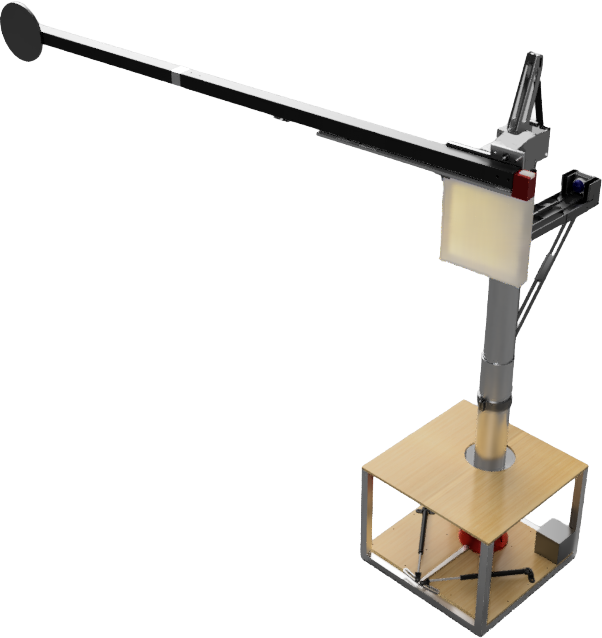
WALL-Y is a robotic wall sanding system designed for use in residential construction sites. It autonomously maps and handles the sanding of interior walls, which is the most repetitive and dust-intensive stage of the finishing workflow, thus reducing strain on workers. Compact enough to navigate one-metre corridors, and light enough to be transported by workers, WALL-Y enables consistent, smooth, paint-ready surfaces free of tool marks (Level 4 finish)Â in spaces where current wall sanding robots simply cannot operate.
Core Features
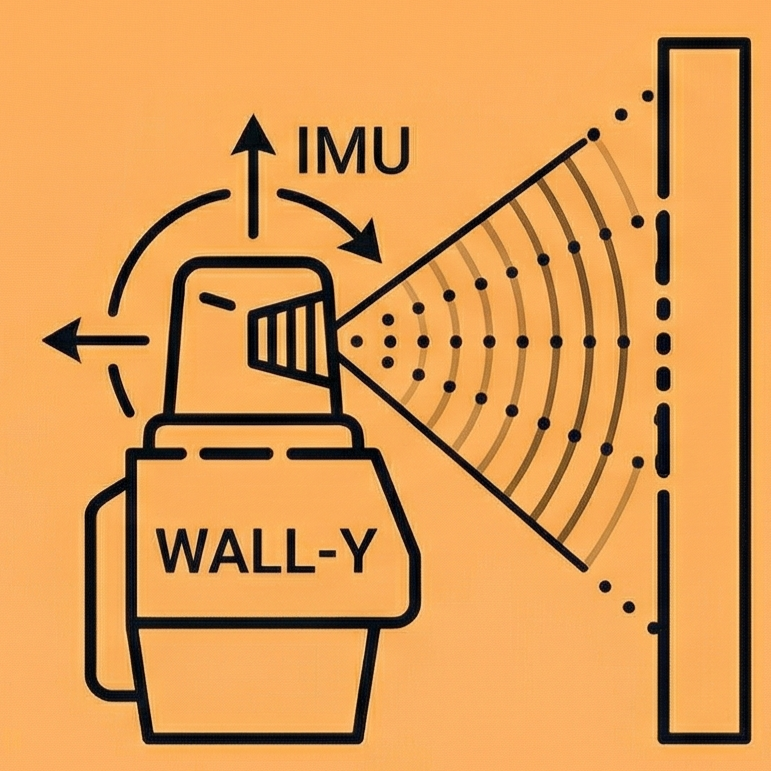
Wall Detection
WALL-Y autonomously identifies and maps the target wall in real time, even in cluttered, dusty construction environments.
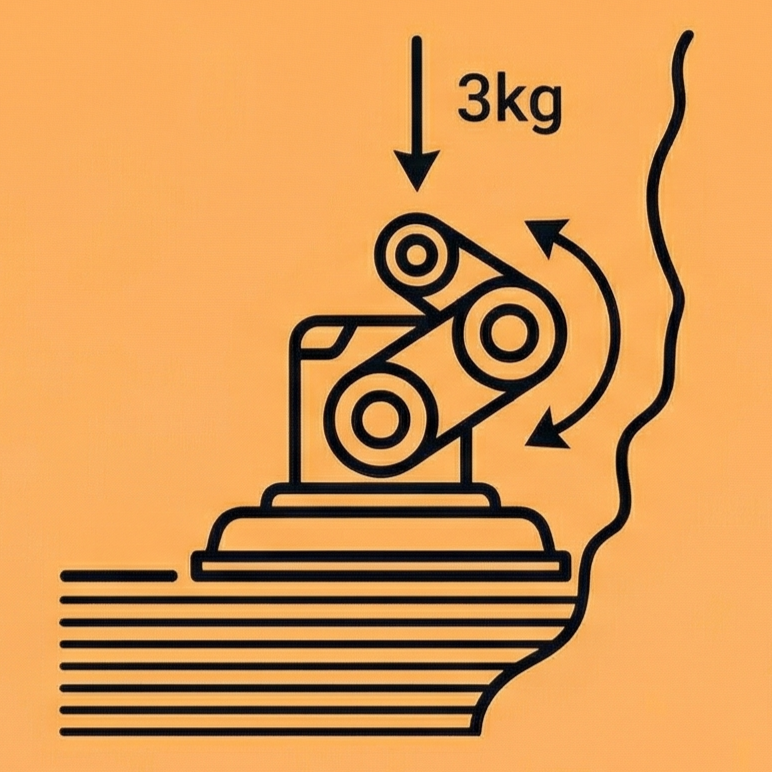
Arc-Based Wall Sanding
Consistent application of 3 kg of force across uneven surfaces to meet Level 4 finishing standards, on surfaces up to 3 metres high.
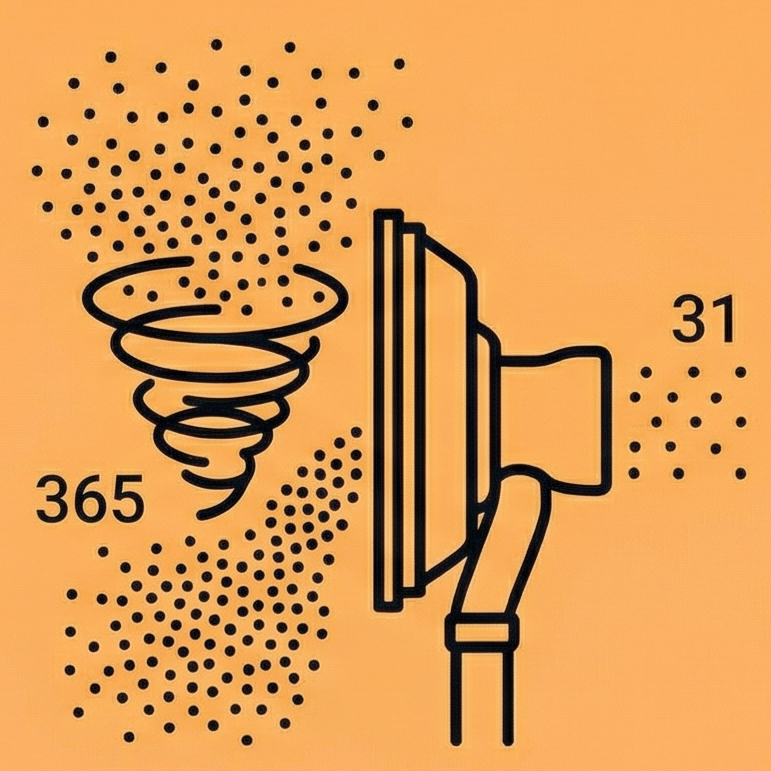
Active Dust Extraction
Reduces PM2.5 concentration from 365 to 31 µg/m³ though an integrated active dust extraction system.
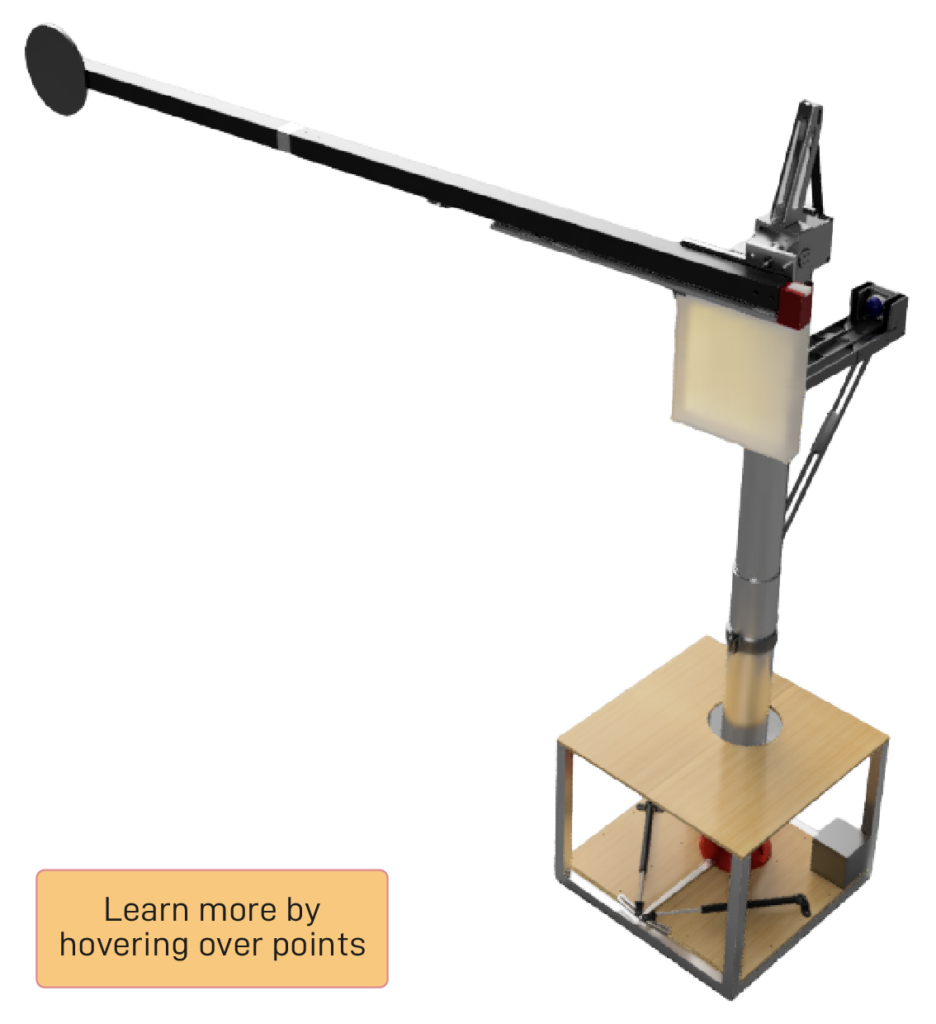
An Overview of WALL-Y
End Effector
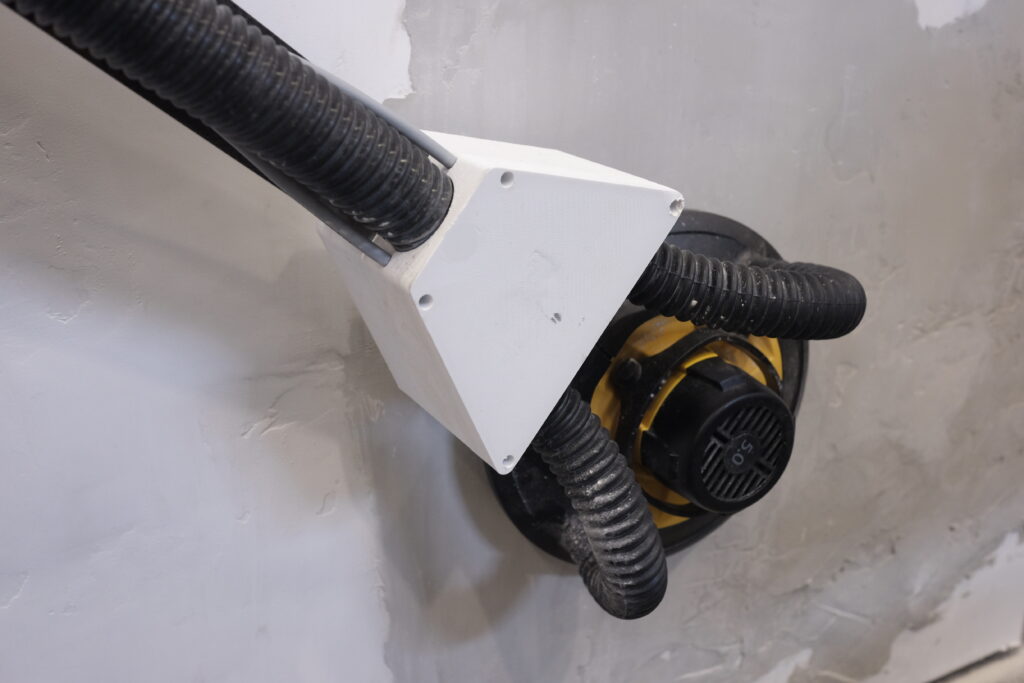
A Mirka LEROS Orbital Sander is attached to the arm tube via a custom adapter, which also acts as a conduit for the vacuum unit to actively extract dust while sanding.
Arm Mechanism
Enables motion in both the pitch and yaw axes.
Utilises gas springs to provide passive compliance, ensuring that the sanding pad applies constant force against walls without the use of complex components.
Counterweight + Particle Damper
Dual-purpose counterweight and particle damper.
Offsets arm payload to minimise motor torque, while internal interactions between particles dissipate vibrations from active sanding head.
Arm Tube
The main arm rotates and extends in broad, overlapping arcs. This allows the robot to efficiently sand large areas without needing to reposition its base.
Base
Acts as the system's foundation, lowering the center of gravity to prevent tipping during maximum arm extension.
WALL-Y covers walls through two complementary motions; through controlled arcing motions of the arm and linear extension to adjust the reach of the sanding head to cover the full width of the wall. At the heart of this is a passive 2-DoF gimbal, which allows the sanding head to articulate freely in both the pitch and yaw axes. A pair of calibrated gas springs govern each axis, applying a continuous restorative force that keeps the sanding pad pressed firmly against the wall at a steady 3 kg to achieve a uniform Level 4 finish across the entire wall.
Dust Extraction
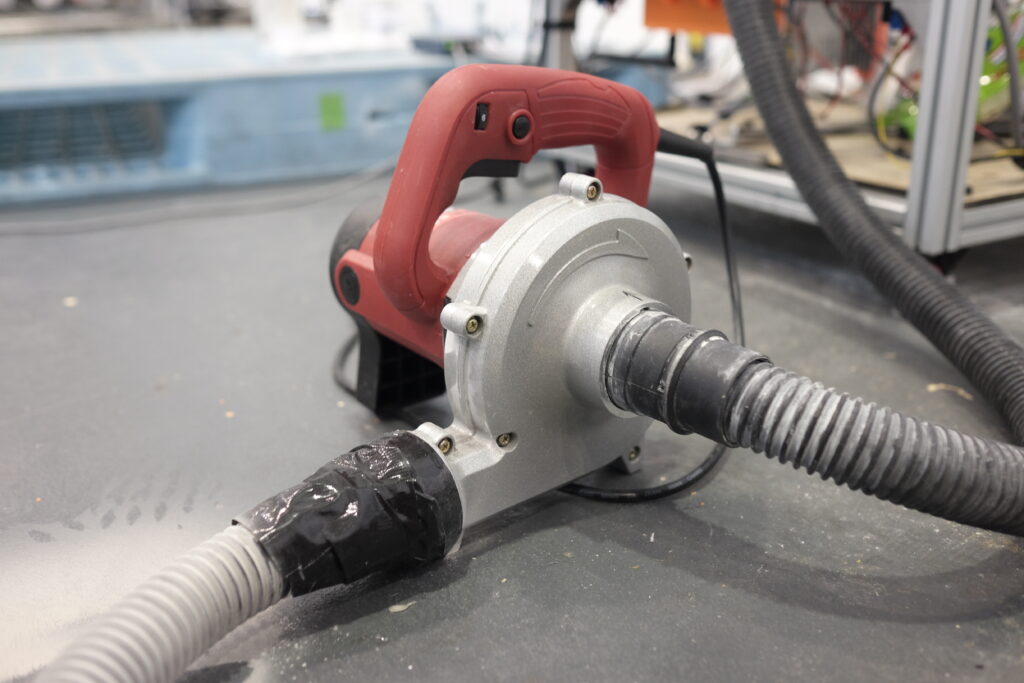
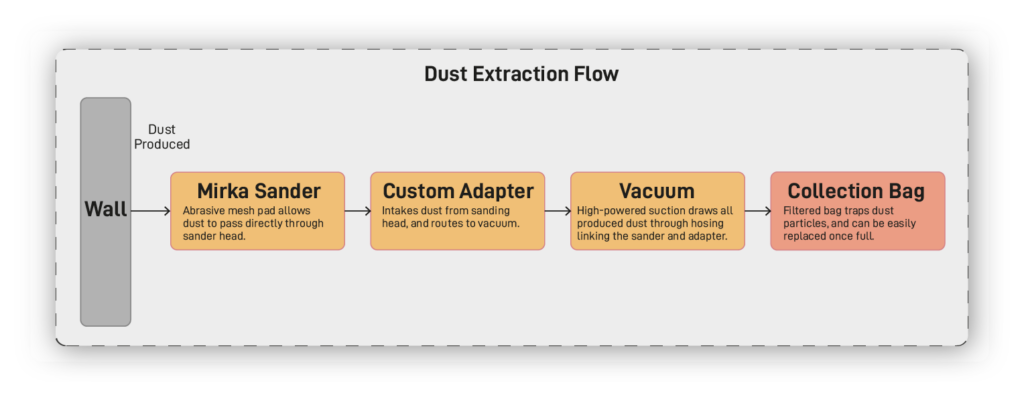
WALL-Y’s dust extraction system is a fully integrated, closed flow. It aims to contain dust from escaping the moment it is generated at the wall. The Mirka sander’s mesh pad draws dust directly into the custom adapter, which routes it through vacuum hosing into a collection bag. The result is a 12 times reduction in PM2.5 concentration, bringing the site back to safe baseline levels.
Software Pipeline
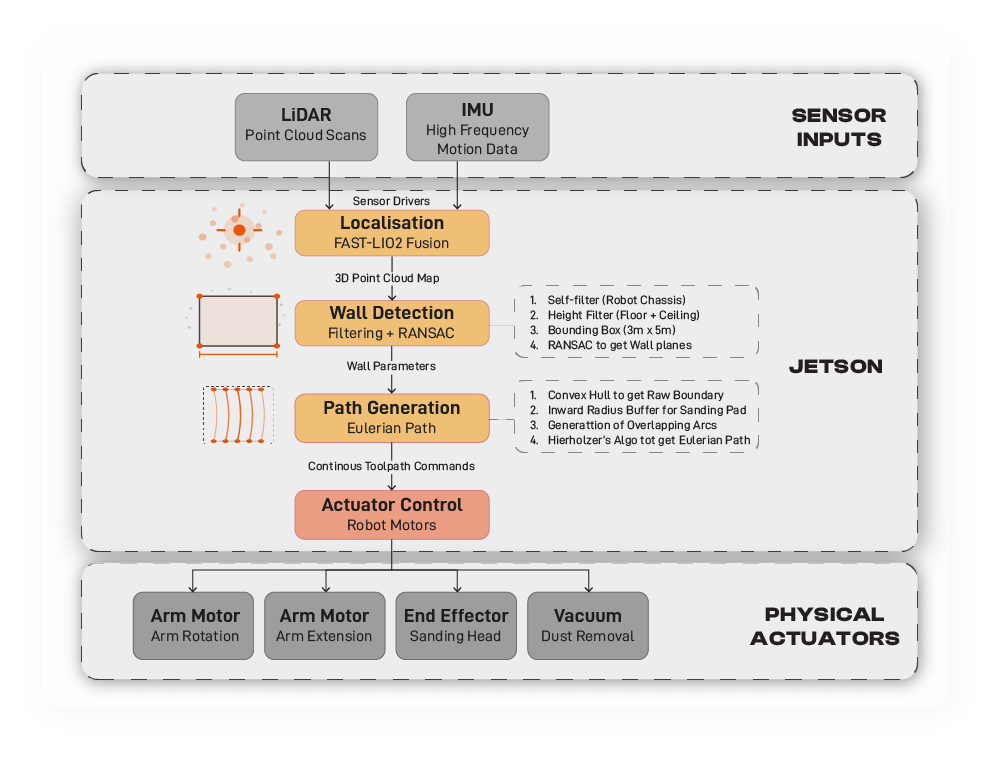
WALL-Y’s software operates as a closed loop between its sensors and its motors. On one end, a LiDAR and an IMU feed raw environmental data into the system continuously. On the other, four physical actuators; two arm motors, the sanding head, and the vacuum, carry out the sanding operation. Everything in between is handled autonomously by the NVIDIA Jetson.
Jetson Utilities
Localisation
WALL-Y’s localisation is powered by FAST-LIO2, an algorithm that fuses data from the LiDAR and IMU sensors in real time. FAST-LIO2 compensates for the high-frequency vibrations generated by the orbital sander, which would otherwise distort the robot’s sense of its own position. The result is a continuously updated, motion-compensated 3D point cloud map of the surrounding environment that remains accurate even during active sanding.
Wall Perception
With a live point cloud in hand, WALL-Y must isolate the specific wall it needs to sand from a cluttered construction environment. This is done through a five-stage filtering pipeline, progressively stripping out the robot’s own body, the floor, the ceiling, and any surfaces out of reach. Afterwards, a RANSAC algorithm is used to identify the dominant wall plane.
Optimised Path Planning
Once the wall is identified and parameterised, WALL-Y computes an optimised sanding route using an Eulerian path algorithm. The wall is divided into fixed-pivot sweep zones, with the arm prioritising angular extension over base movement wherever possible, thus minimising mechanical wear and maximising efficiency. The path is solved as a Chinese Postman Problem, guaranteeing that every point on the wall is covered in a single continuous motion, without the sanding head ever needing to lift off the surface.
Operation Workflow
With the software pipeline handling sensing, detection and path planning, and the mechanical systems delivering consistent force and dust extraction, WALL-Y operates as a fully integrated unit.Â
This is how WALL-Y would be operated on an actual construction site:
The robot's compact 0.56 m by 0.56 m base allows for easy maneuvering through tight corridors typical of active construction sites.
The robot's lightweight construction and compact footprint ensures it can be positioned and deployed quickly by workers, minimising downtime between sanding cycles.
The robot autonomously identifies the target wall plane and extracts its coordinates, dimensions, and distance from the end effector without any manual input.
The robot sands walls up to 3 metres high using an optimised algorithm of sweeping arcs, while actively extracting dust to maintain safe air quality.Â
Workers inspect the surface to confirm that a satisfactory finish has been achieved . They can then proceed to subsequent finishing stages such as painting or wall covering.
Workers can easily move the system to the next location, and the process is repeated.
Acknowledgements
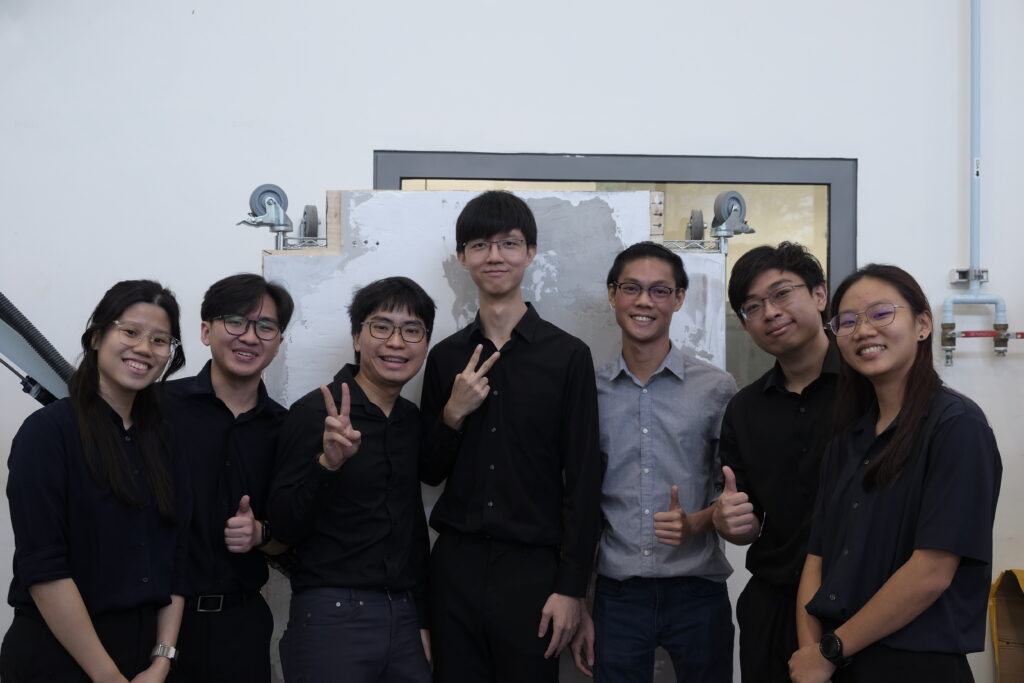
Capstone Group S12 would like to express our heartfelt gratitude to our Capstone mentors: Dr Zhao Fang and Dr Marie Siew, for their invaluable guidance, support, and expertise throughout the course of this project. Their insights have been invaluable in helping us stay on track and in showing us how we could continually refine and strengthen our work.
We also extend our appreciation to our partner company, with their invaluable insights, technical advice, and continuous collaboration which were essential to the vision and development of the robot.
Lastly, we would like to thank our CWR mentor, Dr Susan Wong, for her feedback and constructive advice on both our report, presentation and showcase materials. Her support has strengthened the clarity and communication of our project deliverables.Â